Composition.
DOSAGE: 2 MINUTES
01 — THE SYMBOL
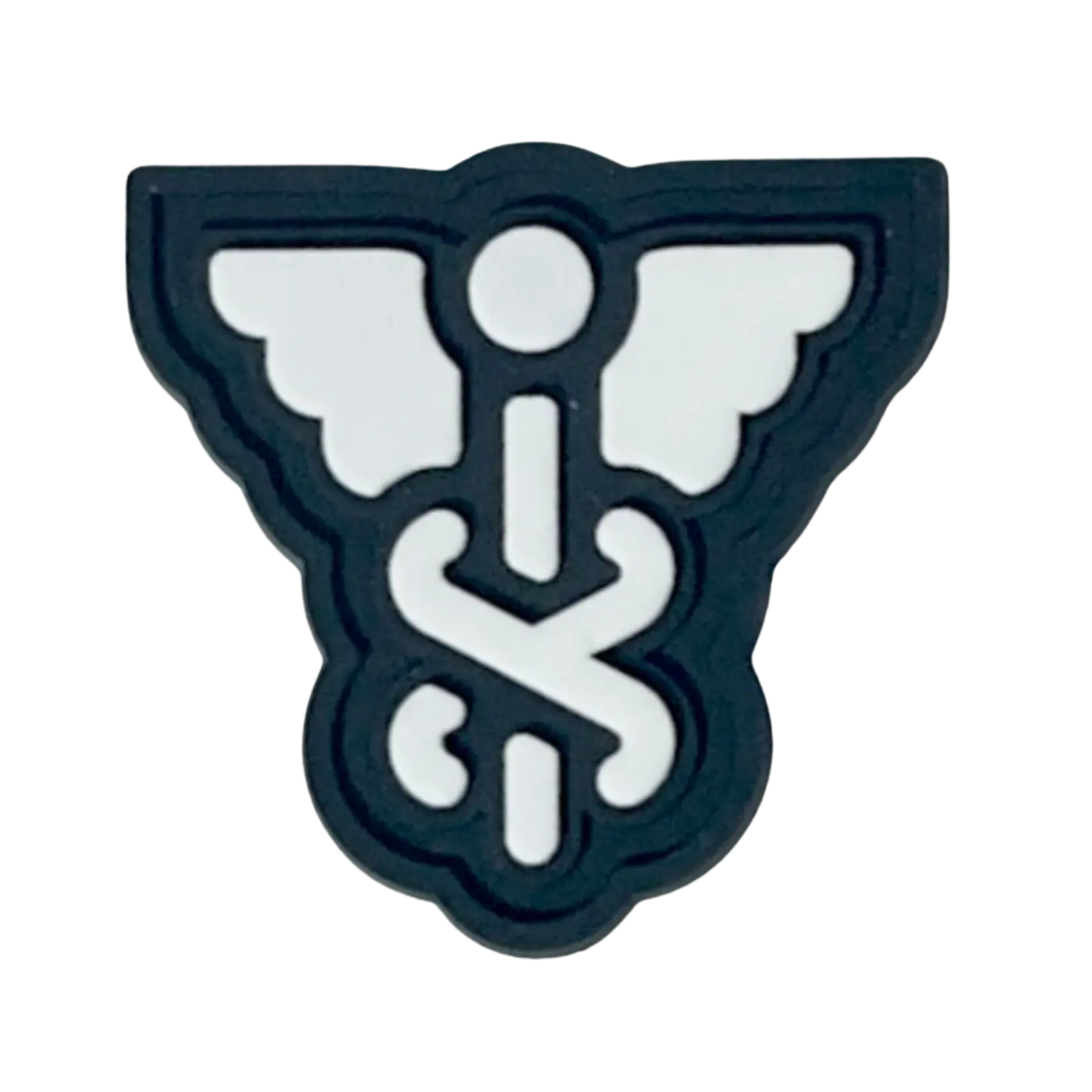
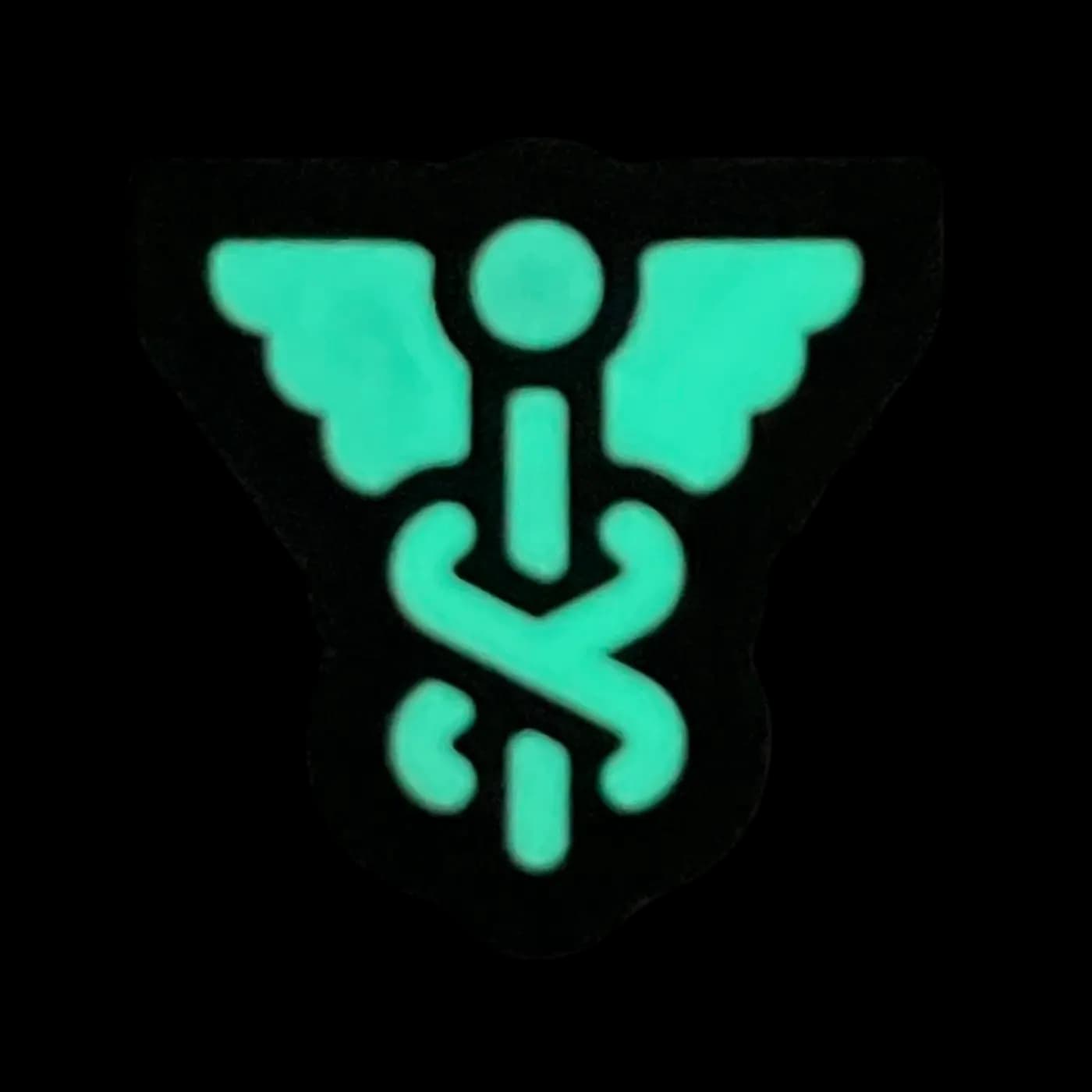
This is a caduceus: a winged staff with two serpents wound around it. It is the wrong one.
The correct medical symbol is the rod of Asclepius: one serpent, no wings, belonging to the Greek god of healing. The caduceus belongs to Hermes, god of commerce, thieves, and messengers, and has nothing to do with medicine at all.
The mistake is not mine. A nineteenth-century medical publisher put it on his printer’s mark, the US Army Medical Corps adopted it in 1902, and it has been painted on ambulances ever since, mistaken for classical authority.1
I have kept it. I am not offering a cure. I am offering knitwear, which puts me under Hermes.
The mark sits on a black patch that glows in the dark. Nothing else here does. When the overhead lighting finally fails, it is the last thing in the room you can see. Dark times were the brief.
02 — THE NAME
Pia mater. Latin, twelfth century: the tender mother. It names the innermost of the three membranes around the brain and spinal cord, the thin one that lies directly on the tissue.2
The name is older than the anatomy it now describes precisely. The tenth-century Persian physician al-Majūsī called the tough outer membrane umm al-qalīẓah, the thick mother, and the delicate inner one umm al-raqīqah, the thin mother, believing the meninges gave rise to every other membrane in the body, the way a mother gives rise to a child. In the twelfth century, the monk Stephen of Antioch translated the pair into Latin: dura mater, pia mater.3 Tender is not quite what raqīqah means. Antioch’s word probably should have been tenue, thin. He wrote pia instead, pious, tender, and pia is the word that stayed.
Nine hundred years on, nobody has corrected him, and I do not intend to start. The soft layer nearest the nerves is the correct thing to name a garment after, even if the word for it is wrong.
03 — THE FINDINGS
For two thousand years, whatever ailed you, you got leeches. I have reviewed the results.
The patients were not improved. The leeches did very well.
The remedies since have offered you a choice. Soft, and cut for a patient. Or interesting, and itching by lunch.
I reject the choice.
Following extensive examination, I have determined that the patient is not malfunctioning. The environment, however, is another matter.
Feeling better shouldn’t require you to become a different person.
I prescribe one strange object and no change of personality.
Nothing I dispense is acrylic. Every specimen’s file lists its fibres exactly, nylon included where there is nylon.
It will not cure anything. It will, however, be soft while the world continues to be run incorrectly.
Made in Ireland.
04 — FOOTNOTES
- The caduceus, a staff with two entwined serpents and wings, is the property of Hermes, god of commerce, thieves, and messengers. The correct medical symbol is the rod of Asclepius: one serpent, no wings. The medical caduceus in wide American use today does not descend from antiquity at all. It derives from the 19th-century printer’s mark of a medical publisher. Wilcox RA, Whitham EM. “The Symbol of Modern Medicine: Why One Snake Is More Than Two.” Annals of Internal Medicine 2003;138(8):673–677. ↩
- The pia mater is the innermost of the three meningeal layers, directly investing the surface of the brain and spinal cord. Adeeb N, Mortazavi MM, Tubbs RS, Cohen-Gadol AA. “The pia mater: a comprehensive review of literature.” Child’s Nervous System 2013;29(10):1803–1810. ↩
- “Tender mother” is a Latin rendering of the Arabic umm raqīqah, coined by the physician al-Majūsī and translated into Latin by Stephen of Antioch around 1127. Pia (“pious”, or “tender”) is generally held to be a mistranslation of the Arabic for “thin”, which has persisted for nine centuries regardless. Adeeb et al., 2013, as above. ↩
Treatment remains available.
@betterthanleeches